
The premium on insurance policies will get costlier by 3 per cent to 7 per cent, depending upon the rate fixed by the GST Council from April 1, 2017, says Harjot Singh Narula.

The FMCG industry hopes for a revival in consumption growth in 2025 with some 'green shoots' already visible, after having a challenging year amid escalating input costs and a double-digit rise in food inflation, which ultimately slowed down the pace of the urban market growth in the second half of 2024. Soaring prices of commodities such as palm oil, coffee, cocoa and wheat forced FMCG players to go for a hike of 3 to 5 per cent or resort to shrinkflation by reducing pack sizes and grammage to retain attractive price points, fearing a volume loss.

ONGC's January-March quarter results for the 2022-23 financial year (Q4FY23) indicated changes in the trends of the energy cycle as well as the impact of policy change in gas-pricing. The public sector oil and gas major reported standalone Ebitda (earnings before interest, tax, depreciation and amortisation) at Rs 16,340 crore, down 12 per cent year-on-year (YoY), and down 20 per cent quarter-on-quarter (QoQ). There was a net loss of Rs 250 crore due to exceptional items of Rs 9,240 crore for provisions related to the ongoing dispute regarding the applicability of service tax and goods and services tax on Royalty.

Infosys Ltd on Thursday reported a 4.7 per cent rise in the September quarter net profit and raised revenue guidance after broadbased growth. Net profit of Rs 6,506 crore in July-September was up 4.7 per cent when compared to Rs 6,212 crore earnings in the same period last year. It was 2.2 per cent higher quarter-on-year, according to a company statement.

The banking sector emerged as an outlier when the rest of India Inc witnessed a slowdown in earnings in FY23. The combined net profit of listed public and private sector banks was up 39.4 per cent year-on-year (YoY) last financial year and their share in India's gross value added (GVA) or gross domestic product (GDP) at factor cost rose to a record high of nearly 1 per cent up, from 0.8 per cent a year ago. Listed banks' combined net profit grew to Rs 2.36 trillion in FY23, from Rs 1.69 trillion a year ago. In comparison, India GVA at current prices was up 15.2 per cent YoY at Rs 247 trillion in FY23; it was around Rs 214 trillion a year ago.

India's economic growth slowed to a 15-month low of 6.7 per cent in April-June 2024-25, mainly due to poor performance of the agriculture and services sectors, government data showed on Friday. The gross domestic product (GDP) expanded by 8.2 per cent in the April-June quarter of 2022-23. India, however, remained the fastest-growing major economy, as China posted a 4.7 per cent growth in April-June 2024.

Anil Rego, CEO, Right Horizons, answers your personal income tax queries.
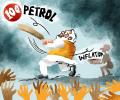
An average Indian spends no more than Rs 1.3 lakh per year, according to official statistics. This is close to what an average Indian earns annually. At this level of per capita income today, one litre of petrol costs one-third of an average Indian's daily income (Delhi prices), making it highly unaffordable. People in most other Asian and emerging countries find it more affordable.

R Vignesh is a member of the Institute of Cost and Management Accountants of India in Chennai, appeared on Rediff Chat to answer readers' queries on GST.

In several areas, the Indian government has put out a model law.

Hospitality players want the government to accord infrastructure status to hotels to make investments on new properties more attractive rather than categorising them as luxury or even 'sin goods' in the upcoming Union Budget considering the sector's potential to play a key role in India's growth. They also want the government to consider incentives in the form of tax breaks or subsidies for adopting sustainable and eco-friendly practices, while asserting that the upcoming budget must accelerate the tourism agenda saying it is an opportunity to make Indian hospitality the emerging engine for GDP growth and employment generation.

The commerce ministry is proposing a host of direct and indirect incentives such as deferral of import duties and exemption from export taxes to revamp Special Economic Zones through a new legislation, an official said. In the Union Budget this year, the government proposed to replace the existing law governing Special Economic Zones (SEZs) with a new legislation to enable states to become partners in 'Development of Enterprise and Service Hubs' (DESH). The official said the commerce ministry has sought views of different ministries, including finance, on the new bill.

These plans aren't likely to put substantial cash in your hands.

The total number of demat accounts in the country stood at 171.1 million as of August 31.
Overhaul of the goods and services tax (GST) structure, including possible changes in the tax slabs, may now be taken up only after the 2024 Lok Sabha elections, given the number of states that are going to the polls in its run-up. "No major overhaul of tax rates is expected in GST until the end of next fiscal year. One major reason for this is that some members of the group of ministers (GoM) - mandated to look at rate rationalisation by the GST Council - are from poll-bound states. Later, this may lead to reconstitution of the panel," a senior government official told Business Standard. Besides, both the Centre and states are not in favour of frequent changes in the tax rates amid inflationary uncertainties; they believe any major change should be brought in after extensive deliberations, according to the official.
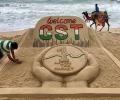
GST collections in June witnessed a 56 per cent year-on-year increase to over Rs 1.44 lakh crore on economic recovery and better anti-evasion measures, the finance ministry said on Friday. Goods and Services Tax (GST) collections in June, 2021 stood at Rs 92,800 crore. Speaking at the GST Day celebrations, Finance Minister Nirmala Sitharaman said Rs 1.4 lakh crore is the "rough bottom line" for monthly GST revenue collections.

The Goods and Services Tax (GST) Council, chaired by Union Finance Minister Nirmala Sitharaman, will likely consider on Saturday a GST rate cut for Covid-19 relief essentials and drugs for treating the black fungus disease and might leave the vaccines untouched. The meeting is being held following a report submitted by a Group of Ministers (GoM) to the GST Council on Monday. The GoM, set up by the Council on May 28, was mandated to look at tax exemption and concessions on various Covid items including vaccines, drugs, and equipment.

E-sports experts say the burgeoning sector will not be affected by the Goods and Services Tax (GST) Council's recent decision to levy a blanket 28 per cent tax on online gaming, which is being viewed by the industry as a death blow to gaming companies.

Because from June 1, 2015, you will have to fork out 14 per cent service tax instead of 12.36 per cent

If the product is genuine, denial is violation of consumer laws.

FinMin does not expect tax or non-tax revenue to reach anywhere close to the targets set in the interim Budget. Sources say that the challenge before the new government will be either to accept the reduced projection and tailor the Budget accordingly or set a more ambitious target.

Finance Minister Nirmala Sitharaman on Wednesday raised the personal income tax rebate limit, doled out sops on small savings and announced one of the biggest hikes in capital spending in the past decade as she did a tight rope walk in the Budget between staying fiscally prudent and meeting public expectations in the year before general elections.

India's tax pie seems to have undergone a subtle change with a sharp drop in direct tax collections resulting from a disproportionate impact of the COVID-19 carnage on incomes. The share of indirect taxes, which mainly comprise of levy on goods and services as well as import duty, has risen while that of direct taxes - made up of corporate and personal income tax - has gone down in 2020. In an interview with PTI, finance secretary Ajay Bhushan Pandey said in a pandemic like this where the economy has been impacted, any large scale changes impact direct taxes more severely, whereas indirect tax collection is mostly proportional to business turnover and compliance.
